Ro Khanna's Road Block
(And not the one in the West Bank)

Ro Khanna ran into a real roadblock this week, and it is not the one you read about in the West Bank. That incident has its own accounting underway. I have plenty of thoughts on that, but none as profound and helpful as Haviv Rettig Gur. He has engaged him directly and in good faith about what happened there. I encourage you to follow him on social media. Few people understand the depth Israeli politics as well as Haviv.
The roadblock I mean is an interview Khanna gave to Jeremy Scahill of Drop Site News. I’ve never heard of that site or individual before, but I watched part of it because the headline told me something was off: Ro Khanna had been found insufficiently anti-Israel for the anti-Israel crowd. Watch what happens when the standard is not “did you tell the truth” but “did you go far enough.”
Khanna was right to refuse that question. Refusing it means he was actually thinking, not just performing for the camera. And that is the real lesson here. The more someone actually knows about this conflict, the harder it becomes to hand them a fantasy and call it a fact. Extremism thrives on people who have not done the reading. It survives on slogans standing in for history, on a headline standing in for an afternoon of research.
Scahill’s question, asked over and over until Khanna would not give him the answer he wanted, was whether Palestinian resistance had the right to target Israeli military installations on October 7. Khanna would not say yes. Scahill treated that refusal as evidence of a double standard, proof that Khanna would excuse Israeli strikes but never Palestinian ones.
Here is the problem. The question is not a hard moral puzzle. It is a fantasy, built to sound reasonable while describing an event that did not happen.
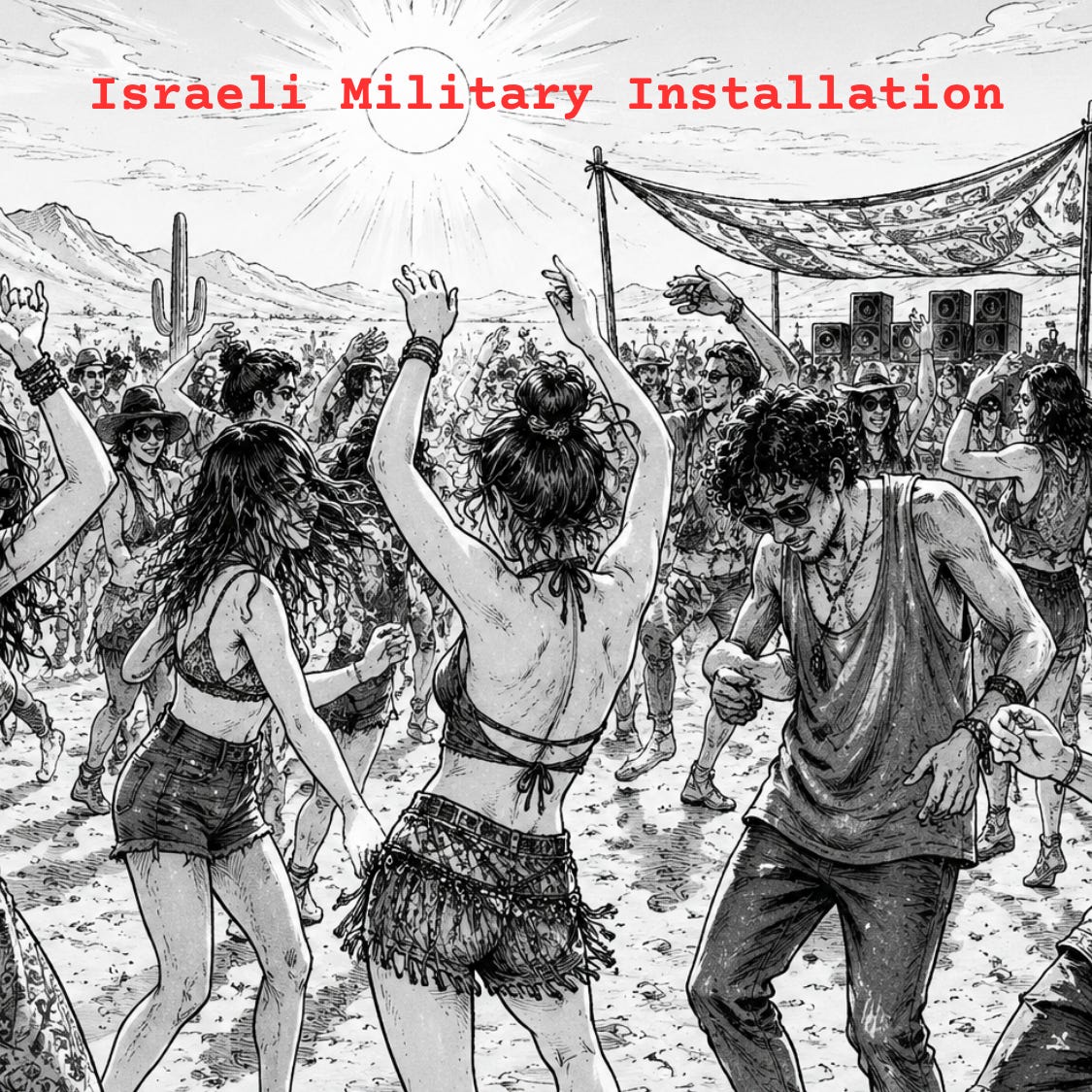
The targets on October 7 were not military bases first and civilians second. They were kibbutzim in the Gaza envelope, communities that were home to some of the most dovish, most pro-peace, most pro-Palestinian Jews in the entire country. They were a music festival where young people were dancing at dawn.
As Haviv Rettig Gur has written, if this conflict had actually been fought military target against military target, we would be living in a very different world right now. It was not. Palestinian armed groups made civilians the primary target, not collateral to one. Israel, even where civilians have tragically been harmed, has operated by a different standard, one that tries to avoid exactly what Hamas set out to do.
So when an interviewer builds a question around “military targets,” he is not asking about October 7. He is asking about an October 7 that exists only in his distorted mind, one scrubbed of the kibbutz dining halls and the safe rooms and the festival grounds. And when a politician gets cornered by that question, refusing to say yes, he is not failing a test of moral courage. He is declining to answer a question that was never honest in the first place.
This is a tactic, and it works on public figures precisely because it sounds like a fair hypothetical. Is it legitimate for an occupied people to strike military targets? Reasonable people can debate that in the abstract. But October 7 is not the abstract. The honest question, the one Scahill did not ask, is whether it was acceptable for Hamas and its partners to murder more than a thousand unarmed civilians. Whether it was acceptable to rape. To behead. To strangle children with bare hands. That is the question if you ask it plainly. Nobody who wants a particular answer asks it plainly.
Watch for this tactic. It will not stop with Ro Khanna, and it will not stop with October 7. Every time someone hands you a hypothetical dressed up as history, ask what got left out to make the hypothetical work.
There are a lot of politicians walking the same road Khanna is on right now. He was a staunch ally of Israel not long ago. I am not ready to give up on the hope that support for Israel can be a bipartisan rally point again, the way it was just a few years back. One way to get there is to keep exposing this kind of distortion, every time it shows up.
Khanna was right to refuse that question. Refusing it means he was actually thinking, not just performing for the camera. And that is the real lesson here. The more someone actually knows about this conflict, the harder it becomes to hand them a fantasy and call it a fact. Extremism thrives on people who have not done the reading. It survives on slogans standing in for history, on a headline standing in for an afternoon of research.
So strip away the rhetoric. Go find out what happened at Be’eri and Kfar Aza and Re’im. Learn who was actually in those kibbutzim and why calling them a military target is a lie. That is not a side project. That is the work. Real change in the Middle East does not come from a better slogan. It comes from people who know enough to reject the fantasy the first time it is handed to them.
You will not get Grandma’s Democrat Party back until the Fettermans, the Hernandez’s, and the Torres’ form a common sense wing to counter the Arab wing, the DSA, and crazed progressives whose only rallying point is hating Trump. Jews among the latter are rightly described by Ayn Reagan as “self-ovening” Jews.